Pos:
Home KnowledgeTechnologyDiamond Copper Composite Materials: A Next-Generation High-Performance Thermal Management Solution for GPU in the AI EraWith the rapid advancement of artificial intelligence, large-scale model training, and high-performance computing, GPU chips are facing unprecedented challenges in power consumption and thermal management. GPU power consumption has evolved from hundreds of watts toward the kilowatt level. Meanwhile, the widespread adoption of advanced process technologies, 2.5D/3D packaging, and high-bandwidth memory (HBM) continues to drive higher chip integration density, resulting in rapidly increasing heat flux density in localized hotspot regions. Traditional copper-based thermal management materials are gradually approaching their performance limits.
Currently, copper remains the dominant material in electronic thermal management due to its excellent thermal conductivity of approximately 400 W/(m·K). However, when the local heat flux density of high-end GPUs exceeds 1,000 W/cm², conventional copper-based heat spreading solutions are no longer sufficient to meet the thermal management requirements of next-generation AI chips. Future competition in AI servers will depend not only on computing architectures but also on the ability to achieve more efficient thermal management. In this context, diamond-copper composite materials are emerging as a critical technology pathway for overcoming GPU thermal limitations.
1. Why Choose Diamond Copper Composite Materials?
Diamond is one of the materials with the highest thermal conductivity in nature, reaching 1,000–2,200 W/(m·K), far exceeding conventional thermal management materials such as copper and aluminum.
However, due to the high cost of single-crystal diamond and the challenges associated with large-scale fabrication, direct application of pure diamond in complex chip thermal structures remains difficult in the short term. Therefore, combining diamond with copper to form diamond-copper composite materials, which integrate exceptional thermal conductivity with engineering manufacturability, has become one of the most promising pathways toward industrial-scale adoption.
Diamond-copper composites combine the advantages of both materials: diamond provides ultra-high thermal conductivity for rapid heat spreading, while copper offers excellent machinability, electrical conductivity, and compatibility with mature semiconductor packaging processes. Compared with conventional copper solutions, diamond-copper composites can significantly reduce thermal resistance and improve heat spreading efficiency, providing more efficient thermal pathways for high-power GPUs, AI servers, and advanced packaging applications.
2. Core Performance Advantages of Diamond-Copper Composite Materials
1) Ultra-High Thermal Conductivity for Enhanced GPU Heat Spreading
Traditional copper materials provide thermal conductivity of approximately 400 W/(m·K). Through optimization of diamond content, interface structure, and manufacturing processes, diamond-copper composites can achieve thermal conductivity of 700–1,000 W/(m·K).
Their superior heat transfer capability enables rapid lateral heat spreading from localized chip hotspots, effectively reducing chip junction temperature and improving GPU sustained performance and operational lifetime.
2) Excellent Thermal Expansion Matching for Improved Packaging Reliability
As GPU packaging advances toward 2.5D/3D architectures, thermal expansion mismatch between chips, packaging substrates, and thermal structures has become increasingly critical. Copper has a relatively high coefficient of thermal expansion (CTE), which can generate thermal-mechanical stress during long-term thermal cycling.
Diamond features a low coefficient of thermal expansion and better compatibility with silicon materials. By integrating diamond with copper, diamond-copper composites can effectively reduce thermal stress and enhance the reliability of high-power semiconductor packaging.
3) Balancing Performance and Cost to Accelerate Industrial Adoption
Compared with pure diamond thermal management solutions, diamond-copper composites offer significant cost advantages. Their manufacturing cost is approximately 10–20% of pure diamond materials, while maintaining substantially higher thermal performance than copper-based solutions.
Therefore, at the current stage, diamond-copper composite materials are considered one of the most promising diamond thermal management technologies for achieving large-scale commercial adoption.
3. Applications of Diamond-Copper Composite Materials in GPU Thermal Management
As GPU power consumption continues to increase, diamond-copper composite materials are expanding from traditional electronic thermal applications into AI computing infrastructure. Key application areas include:
1) GPU Package Lid / Heat Spreader
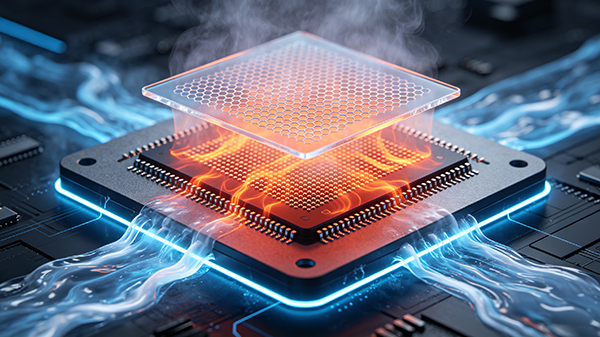
In advanced GPU packaging structures, heat must be rapidly transferred from the chip die to the thermal management system. Diamond-copper composites can serve as high-performance package lids, enhancing top-side heat spreading capability and reducing localized hotspot temperatures.
2) Microchannel Cold Plates for Liquid Cooling Systems
Liquid cooling addresses “how to remove heat from the system,” while diamond-copper composites address “how to transfer heat more efficiently.”
In future high-power AI servers, diamond-copper composites can be integrated into liquid cooling cold plates and microchannel structures to improve heat transfer efficiency between chips and coolant.
3) Thermal Interface Materials (TIMs)
As GPU power continues to rise, interfacial thermal resistance between chips and cooling structures has become a critical limiting factor. Diamond-copper composites can serve as high-performance heat spreading layers, improving thermal transport efficiency from the chip to the cooling system.
4. “Diamond-Copper + Liquid Cooling”: The Future Thermal Architecture for AI Servers
As GPU power enters the kilowatt era, future thermal management systems will require coordinated optimization across materials, packaging, and system-level cooling architectures.
Chip level: Diamond materials enable rapid heat conduction and hotspot control.
Packaging level: Diamond-copper composites provide efficient heat spreading and reduced thermal resistance.
System level: Liquid cooling removes heat at the rack and data center scale.
In other words:
Liquid cooling solves “how to remove heat,” while diamond-copper composites solve “how to transfer heat faster.”
The combination of these two technologies is expected to become a key thermal management architecture for future high-power AI servers.
About CSMH
CSMH is a national high-tech enterprise specializing in the research, development, manufacturing, and commercialization of wide-bandgap semiconductor materials. Its core product portfolio includes polycrystalline diamond materials (diamond wafer, Diamond Heat Sink, diamond window, and diamond-based composite substrates), single crystal diamond (thermal-grade, optical-grade, electronic-grade, and boron-doped diamond), as well as diamond copper composite materials.
Committed to advancing diamond and next-generation material innovation, CSMH enables high-end industrial applications through advanced diamond technologies. Its products are widely applied in lasers, GPU/CPU thermal management, optical communications, medical devices, 5G base stations, high-power LEDs, new energy vehicles, photovoltaic systems, aerospace, and defense industries.
 闽ICP备2021005558号-1
Leave A Message