Pos:
Home KnowledgeTechnologyDiamond Wafer Substrate: Serving as a Heat Dissipation Material for ChipsThe "hotspot" issue in chips demands urgent solutions. As the semiconductor industry advances in line with Moore's Law toward the 2nm, 1nm, and even angstrom-scale nodes, the continuous shrinkage in size coupled with increasing power density has posed unprecedented thermal management challenges. Chips generate substantial heat during operation; without timely heat dissipation, their temperature rises sharply, thereby impairing performance and reliability. When internal heat fails to dissipate effectively, localized "hotspots" form, leading to reduced performance, hardware damage, and soaring costs.
Diamond stands out as an exceptional thermal management material. While traditional metallic heat dissipation materials (e.g., copper, aluminum) offer decent thermal conductivity, they struggle to balance thermal expansion coefficients with requirements for high thermal conductivity and lightweight design. Boasting a thermal conductivity of up to 2000W/m·K, diamond outperforms silicon (Si), silicon carbide (SiC), and gallium arsenide (GaAs) by 13x, 4x, and 43x respectively, and exceeds copper and silver by 4-5x. For applications requiring ultra-high thermal conductivity, diamond remains the sole viable thermal sink material. Its primary applications in heat dissipation include: diamond substrates, thermal sink wafers, and microchannel-integrated diamond structures.
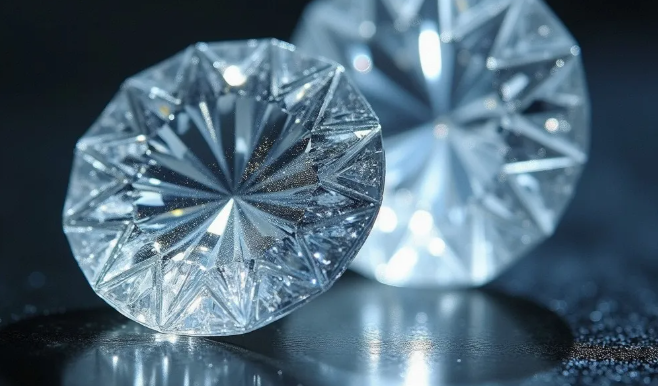
Diamond exhibits remarkable advantages as a semiconductor substrate material:
Ultra-high thermal conductivity: As the most thermally conductive material known to date, diamond enables efficient heat dissipation in high-power-density devices.
Wide bandgap: With a bandgap of approximately 5.5eV, diamond operates stably under high-temperature and high-voltage conditions, making it ideal for high-temperature/high-power electronic devices.
Exceptional current-carrying capacity: Surpassing traditional semiconductor materials, diamond’s current-carrying capacity meets the demands of high-current applications.
Superior mechanical strength: Its hardness and wear resistance ensure stable performance in harsh operating environments, enhancing device reliability and lifespan.
Radiation resistance: Diamond’s radiation tolerance suits applications in high-radiation environments such as aerospace and nuclear energy sectors.
The boron-doped single-crystal diamond produced by CSMH can achieve doping from low concentration to high concentration. It has realized a uniform and controllable concentration and a customizable boron doping process.CSMH uses the MPCVD method to prepare large-sized and high-quality diamonds,and currently has mature products such as diamond heat sinks, diamond wafers, diamond windows,diamond hetero junction integrated composite substrates,etc.
 闽ICP备2021005558号-1
Leave A Message