Pos:
Home KnowledgeTechnologyDiamond Heat Sink : Unprecedented Revolutionary Potential in Optical CommunicationsAs global data traffic surges exponentially, traditional silicon-based optical interconnect technologies are approaching their physical limits, making the quest for next-generation photonic materials an urgent priority. With its extraordinary array of optical and quantum properties, diamond is steadily emerging as a central player in the field of optical communications.
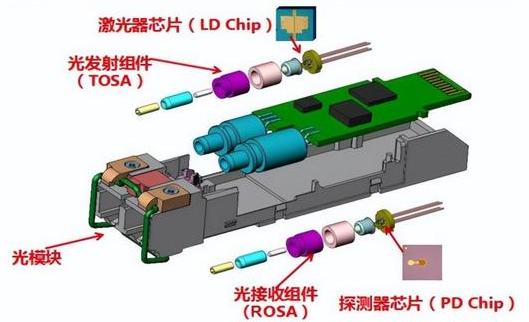
The immense potential of diamond in optical communications stems from its suite of physical properties that approach theoretical limits, collectively enabling performance benchmarks that surpass those of existing materials.
First, its exceptional optical transparency window is truly remarkable. High-purity diamond exhibits ultra-broad transparency, spanning from the deep ultraviolet region at 225 nanometers, through the entire visible spectrum, to the far-infrared (and even microwave) bands. Notably, its extremely low intrinsic absorption in communication-critical wavelengths—such as 1310 nm and 1550 nm—renders it an ideal substrate material for optical waveguides and components. This property allows for the efficient transmission of data-carrying optical signals, laying the groundwork for the development of full-spectrum, low-loss integrated photonic circuits.
Second, diamond boasts an ultra-high thermal conductivity of up to 2200 W/(m·K) at room temperature—five times that of copper and over ten times that of silicon. In high-power, highly integrated optical communication modules (e.g., lasers, modulators, amplifiers), heat dissipation represents a critical bottleneck limiting performance, reliability, and operational lifespan. Diamond’s exceptional thermal conductivity enables it to function as a high-efficiency heat dissipation substrate or integrated heat sink, rapidly channeling away heat generated by devices. This capability significantly enhances the output power, stability, and longevity of such devices, offering an ultimate thermal management solution for next-generation high-power-density photonic integrated circuits (PICs).
Third, diamond exhibits unparalleled mechanical and chemical stability. Its extreme hardness and wear resistance effectively protect against physical damage during manufacturing and operation. Meanwhile, its strong chemical inertness—resisting acid and alkali corrosion—ensures consistent performance even in harsh environments. These attributes endow diamond-based optoelectronic devices with an extended service life and robust environmental adaptability, making them invaluable for constructing highly reliable, maintenance-free photonic systems such as undersea optical cable repeaters and space-based communication equipment.
Leveraging these extraordinary properties, diamond applications in optical communications are advancing comprehensively across three levels: materials, devices, and systems.
At the passive optical device level, diamond’s optical transparency and stability first make it suitable for high-performance optical windows, lenses, and mirror coatings. Furthermore, its high refractive index (~2.4) and low optical loss facilitate the fabrication of diamond optical waveguides. Using techniques such as etching or ion implantation, submicron-scale waveguide structures can be patterned on diamond substrates, tightly confining light fields within microscale channels for ultra-low-loss transmission. This technology underpins the development of ultra-compact, low-loss on-chip optical interconnect networks, which are crucial for future three-dimensional photonic integration and overcoming bandwidth and integration density limitations.
At the active optoelectronic device level, as an ultra-high thermal conductivity substrate, diamond can be bonded with III-V semiconductor lasers (e.g., InP, GaAs) to produce high-power laser diodes with multi-fold output power gains and significantly enhanced reliability—directly applicable to high-capacity fiber optic communication transmitters. For optical modulators, while diamond itself does not exhibit prominent nonlinear optical coefficients, its high-speed carrier transport properties, combined with two-dimensional materials such as graphene, hold promise for the realization of ultra-fast, low-power electro-optic modulators. In the realm of single-photon devices, diamond color centers integrated into nanophotonic structures are widely recognized as high-quality solid-state single-photon sources. Monolithic integration of such "on-chip single-photon sources" with waveguides, filters, and detectors enables the development of fully integrated quantum light source modules, paving the way for the miniaturization and practical deployment of quantum secure communication equipment.
At the quantum optical communication system level, diamond is evolving from a "component" to a "core" element. QKD (Quantum Key Distribution) transmitter chips based on diamond single-photon sources deliver stable and reliable quantum key generation. More cutting-edge applications include using the electron spins of diamond color centers as quantum memories or quantum repeater nodes. In long-distance quantum communication, photon transmission losses restrict direct transmission range. The long coherence time of diamond color centers allows for the temporary storage of quantum states; through operations such as quantum entanglement swapping, segmented quantum repeaters could theoretically be realized, facilitating the construction of a global quantum internet. The diamond platform stands as one of the most competitive physical systems for developing scalable, integrable long-distance quantum networks.
Looking ahead, the development trajectory of diamond in optical communications will feature parallel advancement across multiple fronts. In the short term, applications as ultra-high-performance heat sinks will be the first to achieve commercialization, directly boosting the performance of existing optical modules. In the medium term, high-performance passive devices based on diamond waveguides and integrated single-photon source chips are expected to enter niche markets such as high-reliability defense communications and quantum secure communication networks. In the long run, breakthroughs in material growth and nanomanufacturing technologies will enable the development of multifunctional "diamond on-chip systems"—integrating light generation, modulation, routing, detection, and even quantum information processing on a single chip. Ultimately, this will drive the evolution of optical communication networks toward higher bandwidth, lower power consumption, greater intelligence, and inherently quantum-secure capabilities.
CSMH uses the MPCVD method to prepare large-sized and high-quality diamonds,and currently has mature products such as diamond heat sinks, diamond wafers, diamond windows,diamond composite materials,etc.Among them,the thermal conductivity of diamond heat sinks is 1000-2200w/(m.k), which has been applied in aerospace, high-power semiconductor lasers, optical communication, chip heat dissipation, nuclear fusion and other fields.
 闽ICP备2021005558号-1
Leave A Message