Pos:
Home KnowledgeTechnologyBreakthrough in Diamond Heat Dissipation: “Bottom-Up” Method Cuts Device Core Temperature by 23°C During OperationRecently, a research team at Rice University has developed a scalable diamond heat dissipation layer technology that reduces the operating temperature of electronic devices by 23 degrees Celsius, providing a new engineering approach for high-power chip heat dissipation. The team’s “bottom-up” diamond growth method builds patterned diamond layers directly on chip surfaces to achieve precise heat extraction.
The core of this technology uses microwave plasma chemical vapor deposition (MPCVD) and consists of three main steps: fabricating a patterned “template” on the chip surface via photolithography; depositing nanodiamond “seeds” to lay the foundation for crystal growth; and converting carbon-containing gases into plasma under microwave excitation, where carbon atoms grow layer by layer along the seeds to form a highly thermally conductive diamond layer. Compared with the traditional “top-down” processing approach, this new method avoids material damage and high costs. The technology has been successfully scaled to 2-inch wafer manufacturing, verifying its scalability.

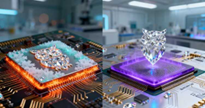
Heat Sink WafersDiamond heat sink wafers are cut and shaped into specific forms, then tightly bonded to chip surfaces to act as high-efficiency “heat transporters” for rapid heat removal. This relatively mature process is used in some radio-frequency power amplifiers, laser diodes, and other applications.
Diamond Composite MaterialsDiamond composites are high-performance materials combining diamond particles with highly thermally conductive metal matrices such as silver, copper, and aluminum. They integrate the ultra-high thermal conductivity of diamond and the excellent electrical conductivity of metals, widely used for heat dissipation in high-power electronic devices.
Microchannel CoolingMicron-scale cooling channels are constructed in diamond or diamond composite materials, enabling high-efficiency heat dissipation via flowing coolant inside. This method suits high-heat-flux power devices, effectively controlling temperature rise and extending device lifespan.
Chemical Vapor Deposition (CVD) Diamond Thin FilmsPatterned diamond heat dissipation layers are grown directly on chip surfaces via MPCVD. High-purity thin films with thermal conductivity close to natural diamond can be prepared on non-diamond substrates (silicon, tungsten, ceramics, etc.), enabling scalable diamond heat dissipation applications.
Diamond heat dissipation technology is moving from “zero to one” toward large-scale adoption. Despite remaining challenges, driven by the surge in AI computing power and technological progress, it will play an increasingly vital role in chip packaging, AI servers, new energy vehicles, and other fields.
 闽ICP备2021005558号-1
Leave A Message