Driven by its unparalleled physicochemical properties, diamond has gradually stood out from numerous materials to become the core material for high-performance AFM probes, propelling nanoscience to explore deeper frontiers.
As the hardest natural material known to humanity, diamond features a tetrahedral arrangement of carbon atoms that forms extremely strong covalent bonds. This unique crystal structure endows diamond with a suite of exceptional properties: it boasts a hardness of up to 100 GPa, making it the hardest natural material in existence; its elastic modulus reaches 1200 GPa, ensuring almost zero deformation under stress; its thermal conductivity hits 2000 W/(m·K), five times that of copper; it exhibits remarkable chemical stability, resisting acid and alkali corrosion; additionally, it possesses excellent wear resistance and stable electrical performance.
In AFM probe applications, these inherent properties of diamond translate into distinct advantages:
Exceptional Wear Resistance: Traditional silicon probes show noticeable tip wear after just tens of scans in contact mode, whereas diamond probes can withstand millions of scans, extending service life by over ten thousand times.
Unmatched Stiffness: The high elastic modulus ensures minimal probe deformation under force, delivering more accurate and reliable measurement results.
Stable Thermal Performance: High thermal conductivity enables rapid heat dissipation during operation, eliminating measurement errors caused by thermal drift.
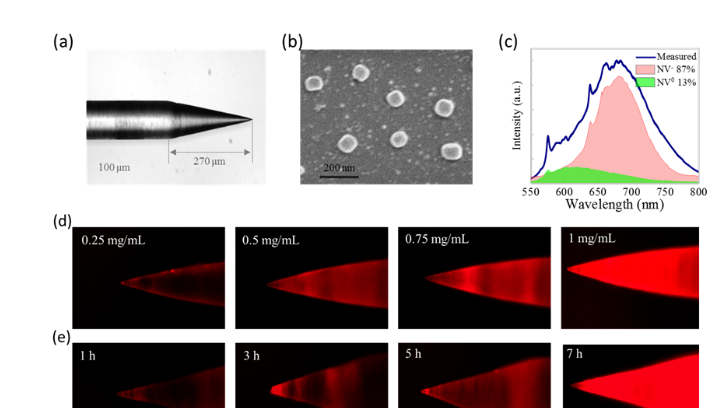
Versatility: By tuning diamond doping types (boron-doped or nitrogen-doped), conductive or insulating probes can be fabricated, expanding the scope of applications.
The ultra-high hardness and sharpness of diamond probes enable atomic-scale resolution imaging. In contact mode, diamond probes can stably scan sample surfaces to capture true surface morphologies. Single-crystal diamond probes have been successfully used to observe the dynamic evolution of individual oxygen vacancies on titanium dioxide surfaces, providing direct evidence for the study of surface catalytic mechanisms.
Leveraging the excellent mechanical properties of diamond probes, nanoscale scribing, imprinting and modification can be performed on material surfaces. A thermomechanical nanomachining system based on diamond probes has achieved the fabrication of complex structures with feature sizes below 10 nanometers on polymer surfaces, opening up new avenues for the manufacturing of nano-optoelectronic devices.
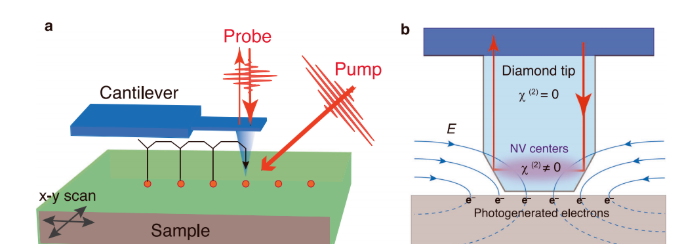
The rigidity of diamond probes makes them ideal tools for nanoindentation testing. By measuring the force-displacement curves during probe loading and unloading cycles, key mechanical parameters of materials—including elastic modulus, hardness and fracture toughness—can be obtained. Diamond probe systems have been employed to study the mechanical behavior of carbon nanotubes, improving measurement precision by an order of magnitude compared with traditional methods.
Doped diamond probes, which combine electrical conductivity and electrochemical inertness, are the ideal choice for Scanning Electrochemical Microscopy (SECM) and Scanning Kelvin Probe Microscopy (SKPM). Boron-doped diamond probes maintain ultra-low background current across a wide potential window, enabling the study of ion channel activities on single-cell surfaces with spatiotemporal resolution down to the millisecond and nanometer scale.
Functionalized diamond probes excel in single-molecule force spectroscopy research. Through surface modification, diamond probes can be conjugated to specific biomolecules to measure mechanical responses during processes such as protein folding/unfolding, DNA stretching, and receptor-ligand interactions.
With the continuous advancement of nanotechnology, the performance requirements for AFM probes are rising steadily. Endowed with unique performance advantages, diamond probes demonstrate enormous potential in ultra-high-resolution imaging, nanomanufacturing, single-molecule detection and other cutting-edge fields. From the accidental use of natural diamonds to the precise and controllable production via modern CVD technology, the evolution of diamond AFM probes not only reflects the progress of materials science, but also embodies humanity’s relentless spirit of exploring the nanoworld.
CSMH uses the MPCVD method to prepare large-sized and high-quality diamonds,and currently has mature products such as diamond heat sinks, diamond wafers, diamond windows,diamond composite materials,etc.Among them,the thermal conductivity of diamond heat sinks is 1000-2200w/(m.k), which has been applied in aerospace, high-power semiconductor lasers, optical communication, chip heat dissipation, nuclear fusion and other fields.
 闽ICP备2021005558号-1
Leave A Message